E-Catalog > Sanwa Enterprise Company, Ltd. > JET COOLER (COLD AIR GENERATOR)

PAGE VIEW : 10,723

Product Information :

Name :
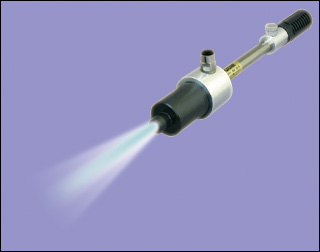
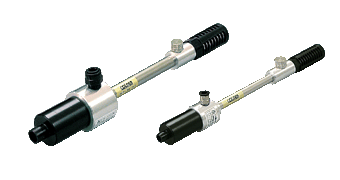
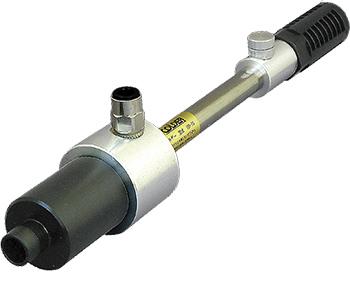
JET COOLER (COLD AIR GENERATOR)
Category :
  1. เครื่องจักร, อุปกรณ์เกี่ยวกับเครื่องจักร, เครื่องมือกล
Sub - Category :
  1. Sanwa Enterprise Company, Ltd.
Brand :
SANWA
Model :
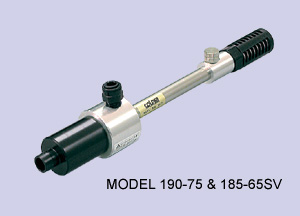
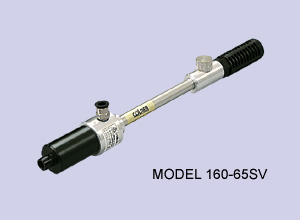
JET COOLER (COLD AIR GENERATOR)190-75SV 185-65SV 160-65SV
Product Type :
  1. สินค้า, ผลิตภัณฑ์
Short Description :
SANWA JET COOLER (COLD AIR GENERATOR)190-75SV 185-65SV 160-65SV

Product Detail :


Performance of the UCAG model
 
Models Compressed-air
(Mpa)
Air consumption
(l/min)
Cold air ratio
(%)
Lowest temp. obtained
()
*1
Max. temp. difference
()
Weight
(g)
Compressor capacity
*2
190-75SV 0.3 - 0.7 290 - 650 20 - 85 -50 70 335 5KW -
185-65SV 0.3 - 0.7 170 - 360 20 - 85 -45 65 335 3.5KW -
160-65SV 0.3 - 0.7 110 - 220 15 - 70 -45 65 147 2KW -
*1 In case of compressed- air pressure 0.7Mpa, intake air temp.20(without silencer)
*2 Compressor capacity to obtain Lowest temp.
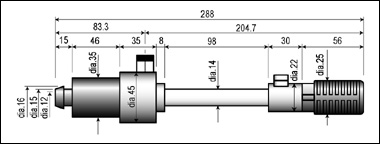
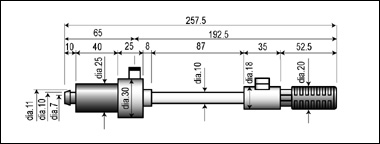
  Dimensions
   
Graph A-1  


Graph B-1
 
 
Performance--------In case of the UCAG 190-75SV
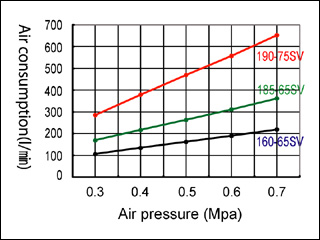
In case compressed- air pressure is 0.7Mpa, the UCAG consumes 650 l/min of air( Refer to graph A-1). The temperature difference between cold air and compressed-air as well as cold air volume can be regulated with control knob.
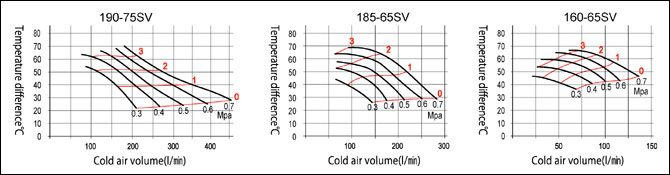
For instance, if you turn the knob 360 degree from complete closed position, you can obtain cold air of 350 l/min with the temperature difference of 40 .
(Refer to graph B-1. Difference of the temperature on the graph was measured by digital temperature gauge at about 50-60mm inside from the cold air outlet to minimize influence of the ambient air. )
For specific applications, choose the combinations of cold air temperature and volume as needed with control knob.
Performance of each model
 
Models Pressure of 
supplied air (Mpa)
0.3 0.4 0.5 0.6 0.7
190-75SV W
*1
158 204 253 294 343
1.5 1.5 2 2 2
185-65SV W
*1
94 142 184 232 279
0.5 1 1 1.5 1.5
160-65SV W
*1
57 81 105 123 156
0 0 1 1 1
*1 Number of turn of control knob : Anti- clockwise turn of control knob from fully turned position.
* Operational conditions: Ambient air temperature 20, compressed air temperature at inlet 20, dry air ( dew point -40).
* Note that above figures are for reference only and vary according to the actual operational conditions.
Option  
 
 
    160-65SV 185-65SV
190-75SV
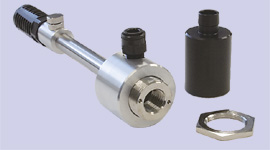
Optional Lock nut 
(for mounting)
Thread standard M20x1 M28x1
Panel hole diameter 20mm 28mm
Panel thickness max. 2.3mm 2.3mm
Parts No. RN20 RN28

he UCAG uses nothing but compressed-air and uses neither electric power nor chlorofluorocarbon(CFC) which is one of the factors of environmental destruction. Just connect the UCAG to the compressed-air line to obtain the air at -50 (in case using compressed-air at +20 with 0.7Mpa(7kg/) on the UCAG model 190-75SV).
Ultra-cold air is most typically applied to the removal of heat generated in the process of machining, cutting metals and plastics. The UCAG performs excellently particularly on the materials with hardness and viscosity such as titanium alloy, stainless steel, super-alloy, thermo-plastics etc.
Cooling effect on the work piece and tool increases machining speed and extends tool life.
The UCAG has been utilized, producing remarkable results, for a variety of spot cooling such as cooling electrical and instrumental enclosures to prevent troubles caused by heat, mold tools, semiconductors and PC base for test and further, dry machining of magnesium alloys.


Applications
For a variety of spot cooling such as :
Cooling metal machining process
Cooling plastic machining process
Air conditioning control box
Precision spot cooling on mold tool
Cooling food processing
easy to install and operate
no moving parts, small and lightweight
no use of CFC and chemical agent
no spark hazard, RFI/EMI
instant ON/OFF, easy to control
maintenance free, durable construction
   
improve tool life, allow for high speed machining
reduce tool wear, no heat deformation, 
ensure exacting tolerance
eliminate liquid coolants, no hazardous mists
no washing needed by keeping work-piece clean
clean and safe operation by blowing off tips
clean floor and people at work, safe operation
free from corrosion caused by additives to oils.
no skills are required, reduce operational cost
free from stress cracking on work-piece
   
It has been almost 30 years since Sanwa Enterprise Company, Ltd. started manufacturing of the UCAG. 
Small and lightweight the UCAG which operates without electric power source has now become a synonym for simple cooling system in Japanese spot cooling system market.
Used in a broad range of applications, UCAG has been performing excellently at over a thousand of enterprises including automobile-related companies.


Question 1: How ultra- low temperature air is generated by the UCAG ?
Question 2: How long is the life of the UCAG ?
Question 3: I have a product to be cooled , but I do not know how to determine the adequate model of the UCAG.

 
Question 1: How ultra- low temperature air is generated by the UCAG ?

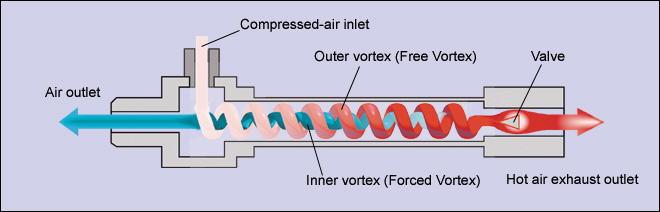
Ultra- low temperature air is generated by the UCAG applying the Vortex Tube Theory.
After entering into the UCAG , compressed-air goes through several nozzles which are designed to force the air to spin. The air , being transformed into spinning air , undergoes separation into cold air and hot air , and the cold air moves to the cold end of the UCAG.

Question 2: How long is the life of the UCAG ?

The UCAG has no movable parts and uses no cooling medium. If incoming compressed air is clean, no maintenance is needed and the life of the UCAG will be an indefinite period of time.

Question 3: I have a product to be cooled , but I do not know how to determine the adequate model of the UCAG.

This is really a bother to everyone.
As a first step, gather information on the product you want to cool, such as material, size, weight, actual and desired temperature of the product, inner heat, etc. Based on these information, the amount of heat to be removed to cool the product can be calculated.
Next, collect information on use environment of the UCAG, such as compressed air volume, pipe diameter of compressed- air supply, compressed-air pressure, with or without valves, etc. 
Lastly, determine the adequate UCAG model and its number of pieces to be used by comparing the amount of heat to be removed to cool the product and capacity of each UCAG model.

 
However, determining the adequate UCAG model might be a little complicated work for everyone because various factors are intricately involved. Sanwa’s sales staffs are always ready to help you select the adequate model of the UCAG with full confidence.


Method for determining Heat Removal Requirements
 
Step1:   Collect information and data about a product to be cooled

  Specific heat (J/kg・)
  Weight (kg)
  Temperature difference (t) 
( actual temperature minus desired temperature )
  Cooling time (sec)
Step2:   Determine the amount of heat ( per second )to be removed to cool the product (Heat Removal Requirements ) by applying the following formula to the above information.

   
Heat Removal Requirements (W) =   Weight (kg)x Specific heat (J/kg・)x Temperature difference (t)
 
Cooling time (sec)
Step3:   Safety ratio and selection of the adequate UCAG model

1)   Determine heat removal requirements including various losses (Heat Removal Requirements Including Losses ) based on Heat Removal Requirements obtained in the above Step 2. 
In selection of the adequate UCAG model, take into consideration losses ( efficiency 60-80%) derived from shape of the product, distance between the cold end of the UCAG and the product, etc. In case of cooling the product down below the ambient temperature, take into consideration heat which the product absorbs from ambient surrounding.

*   All the heat (cold air) from the UCAG cannot be absorbed by the product.
*   Heat Removal Requirements Including Losses = (Heat Removal Requirements of Step 2) / (efficiency (0.6∼0.8))

2)   Confirm the available compressed- air pressure and select the adequate model of the UCAG.

*   The available compressed- air pressure at the inlet of the UCAG should be confirmed. 
( not the compressed- air pressure at the outlet of compressor )
*   Confirm the air consumption of each model of the UCAG under the each available compressed- air pressure.


Example of determining Heat Removal Requirements
 
Step1:   Taking an iron product as an example,

  Specific heat of the product = 460 J/kg・
  Weight = 1kg
  Temperature difference (t) = Temperature of the product 50 - Desired temperature 30 = 20
  Cooling time = 40sec
Step2:  
Heat Removal Requirements (W) =   1Kg x 460(J/kg・) x 20
 
40(sec)
=   230(W)
Step3:    
1)   Determine Heat Removal Requirements Including Losses based on the above Heat Removal Requirements of Step2, supposing efficiency is 0.7.
Heat Removal Requirements Including Losses =230 (W) / 0.7 = 329 ( W )

2)   Select the adequate UCAG model confirming available compressed-air pressure.
For example, with available compressed -air pressure at 0.7Mpa, the UCAG model 190-75SV has a cooling capacity of 343(W).
And, at this time, air consumption is approximately 650 l/m.

  Above Heat Removal Requirements is just a calculated figure. Actually, as various factors including radiation heat have an intricate affect, above calculated figure should be considered only as an index. And there are losses which vary depending on a number of factors, such as distance between the UCAG and the product, size and shape of the product, etc.


Performance of the UCAG model
 
Models Compressed-air
(Mpa)
Air consumption
(l/min)
Cold air ratio
(%)
Lowest temp. obtained
()
*1
Max. temp. difference
()
Weight
(g)
Compressor capacity
*2
190-75SV 0.3 - 0.7 290 - 650 20 - 85 -50 70 335 5KW -
185-65SV 0.3 - 0.7 170 - 360 20 - 85 -45 65 335 3.5KW -
160-65SV 0.3 - 0.7 110 - 220 15 - 70 -45 65 147 2KW -
*1 In case of compressed- air pressure 0.7Mpa, intake air temp.20(without silencer)
*2 Compressor capacity to obtain Lowest temp.
  Dimensions
   
Graph A-1  


Graph B-1
 
 
Performance--------In case of the UCAG 190-75SV
In case compressed- air pressure is 0.7Mpa, the UCAG consumes 650 l/min of air( Refer to graph A-1). The temperature difference between cold air and compressed-air as well as cold air volume can be regulated with control knob.
For instance, if you turn the knob 360 degree from complete closed position, you can obtain cold air of 350 l/min with the temperature difference of 40 .
(Refer to graph B-1. Difference of the temperature on the graph was measured by digital temperature gauge at about 50-60mm inside from the cold air outlet to minimize influence of the ambient air. )
For specific applications, choose the combinations of cold air temperature and volume as needed with control knob.
Performance of each model
 
Models Pressure of 
supplied air (Mpa)
0.3 0.4 0.5 0.6 0.7
190-75SV W
*1
158 204 253 294 343
1.5 1.5 2 2 2
185-65SV W
*1
94 142 184 232 279
0.5 1 1 1.5 1.5
160-65SV W
*1
57 81 105 123 156
0 0 1 1 1
*1 Number of turn of control knob : Anti- clockwise turn of control knob from fully turned position.
* Operational conditions: Ambient air temperature 20, compressed air temperature at inlet 20, dry air ( dew point -40).
* Note that above figures are for reference only and vary according to the actual operational conditions.
Option  
 
 
    160-65SV 185-65SV
190-75SV
Optional Lock nut 
(for mounting)
Thread standard M20x1 M28x1
Panel hole diameter 20mm 28mm
Panel thickness max. 2.3mm 2.3mm
Parts No. RN20 RN28


Other Product In Group "Sanwa Enterprise Company, Ltd. (1)"